The Quantum Leap: NASA’s Next-Generation Tools for Earth Science
04/13/2026 — From time machines to slipstream drives, quantum technology powers some of our most enduring science-fiction adventures. But at NASA’s Earth Science Division (ESD), quantum technology is a very real tool that promises to revolutionize how we understand our world.
Across the country, NASA scientists and their partners in industry and academia are exploring ways to leverage quantum phenomena, like laser-cooled atom interferometry and high-energy Rydberg atoms, to create first-of-their-kind sensors capable of collecting Earth science data with levels of precision difficult to achieve using even the most state-of-the-art classical techniques. At the same time, NASA scientists are also creating novel algorithms and models that will use quantum computing to answer questions too complex for classical computers.
All these quantum tools could help farmers forecast crop yields with greater precision, assist meteorologists as they predict severe weather, and even probe Earth’s subsurface for aquifers, mineral deposits, and other essential resources.
Mapping Earth’s mass with matter
“Quantum sensing has a lot of potential to break through current limitations. Not only with sensitivity, but also stability, being able to take these measurements very stably over time,” said Anand Mylapore, a researcher at NASA’s Goddard Space Flight Center (GSFC) and co-investigator for NASA’s Quantum Engineering and Sensing Technology laboratory.
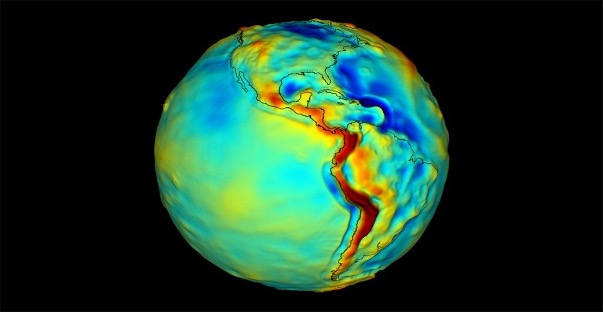
A map of Earth’s gravity. Red indicates areas of the world that exert greater gravitational pull, while blue indicates areas that exert less. A science-grade quantum gravity gradiometer could one day make maps like this with unprecedented accuracy. Credit: NASA
Mylapore is part of a team developing the laser subsystem for NASA’s Quantum Gravity Gradiometer Pathfinder (QGGPf) instrument. Scheduled to fly no earlier than 2030, this space-based instrument will be the first to observe Earth’s gravity field with an atom interferometer.
Atom interferometry exploits the wave-like nature of atoms to measure gravity by splitting and recombining their quantum states to create interference patterns. These patterns are extremely sensitive to inertial forces, enabling ultra-precise measurements of gravity that scientists can correlate to aquifers and other subsurface features difficult to detect with today’s sensors.
“QGGPf is a pioneering instrument in many ways for quantum sensing, because it’s the first practical application of a quantum sensor in space,” said Mylapore.
Smaller sensors, bigger science
Jason Hyon, the Chief Technologist at NASA’s Jet Propulsion Laboratory (JPL) Earth Science and Technology and Director of JPL’s Quantum Space Innovation Center, explained that quantum sensors offer significant advantages compared to classical sensors.
“You’re achieving higher precision and also lower cost, because quantum sensors tend to be smaller than traditional instruments. And we are advancing them with our industry and university partners,” said Hyon.
Researchers at JPL are exploring how ensembles of atoms excited to high-energy states with lasers, known as Rydberg atoms, could be used to observe soil moisture, a key variable in the agricultural forecasts farmers use to anticipate crop yields.
Darmindra Arumugam, a research scientist at JPL, explained that, in a Rydberg state, atoms become uniquely sensitive to electromagnetic signals. Arumugam wants to harness that sensitivity to replace large antennas for detecting radar signals with atomic vapor cells, which are smaller, lighter, and more precise.
“Unlike classical antennas, Rydberg receivers directly detect radio-frequency signals using atomic transitions,” said Arumugam. This equips Rydberg radar with a multiband capability that allows the instrument to probe soil moisture at different depths and under a variety of conditions, improving the quality of an essential variable in agricultural models.
Processing data with quantum computing
While quantum sensors like QGGPf and Rydberg radar aim to collect groundbreaking Earth science data, quantum computing projects currently in development could help scientists maximize the value of data collected with sensors already in orbit.
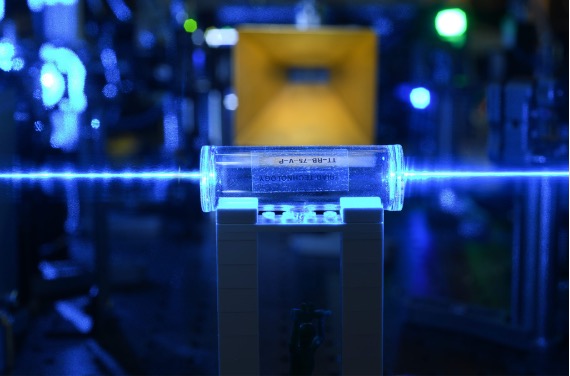
Laser beams excite rubidium atoms in an atomic vapor cell to a Rydberg state to measure microwave signals. These tiny cells could one day replace traditional radar antennas. Credit: US Army
Xiaomei Lu, a research scientist at NASA’s Langley Research Center, is working on a software for quantum computers that uses entropy quantum computing, a specialized computing method used to solve complex optimization problems, to remove background noise from lidar data.
Classical computers would struggle to remove this noise, especially interference caused by sunlight, in a reasonable amount of time, but quantum computers could accomplish this feat almost instantly.
Currently, lidar instruments require particularly powerful lasers to mitigate background noise caused by sunlight. Using quantum computers to filter out background noise would also reduce a lidar instrument’s energy requirements and its mass, making lidar missions less expensive.
“It’s like restoring an old photo, where we can’t see a person’s face clearly. If there are cloud layers or smoke in the atmosphere, the satellite measurements are very noisy, and we need to get the true information buried in that noise,” said Lu. Eventually, Lu hopes to develop a quantum computer that can fly in low-Earth orbit and process new lidar data in real time.
Creating quantum machines capable of surviving the intense shocks of launch and the harsh environment of space is a monumental engineering challenge. But it’s tackling challenges like this that make NASA a world-leading force in space innovation.
“I want NASA to be the first ones to fly a quantum computer in space,” said Lu.
NASA’s Earth Science Technology Office (ESTO) leads ESD’s efforts to develop novel quantum technology. For more information about ESTO, visit: esto.nasa.gov.
Gage Taylor, NASA Earth Science Technology Office